Death
Death — Upright
In a tarot spread, the Death card heralds a period of favorable changes promising liberation and rebirth. It is a time of starting a new phase in life, where future expectations are filled with hope.
The card may indicate changes in the life of the querent, including relocation, a change of job, or a complete shift in worldview, as the past is left behind.
On an emotional level, the Death card symbolizes a complete renewal of the emotional sphere. Outdated emotional patterns no longer restrict the querent, allowing them to shed destructive, tense, or overly sentimental character traits.
Thanks to this card, past sorrows are forgotten, making way for emotional healing, tranquility, and harmony in love.
A meaning is only the beginning.
Explore what this card brings to your own question.
Death — Reversed
At the present moment, the querent is facing a temporary standstill, a feeling of hopelessness, or a period of stagnation leading to a dead end. However, this state is temporary; the situation will soon begin to evolve and move forward.
Astrology
Death aligns with Scorpio, ruled by Pluto, the planet of transformation, endings, and rebirth. This energy reflects deep emotional change, letting go, and renewal. Scorpio's intensity supports cycles of death and regeneration.
Numerology
Number 13 symbolizes endings, transformation, and rebirth. It reflects the essence of the card’s role in the journey, guiding insight through the lens of 4. The reduced number 4 brings focus to universal lessons and recurring themes.
Symbolism & Archetypes
Explore the symbolism — open a section to read more.
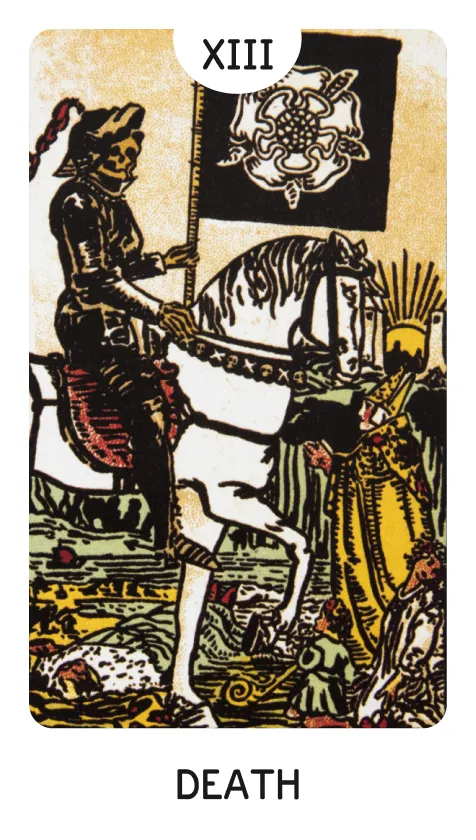
The Death card in Tarot is associated with the Hebrew letter Nun and the zodiac sign of Scorpio, reflecting the profound significance of transformation and transition. Arthur Waite, in his interpretation of this arcana, departs from the traditional French design by presenting a skeleton-rider symbolizing Scorpio.
The skull and bones on the horse's bridle emphasize the connection with this sign.
Unique elements in Waite's version include:
The hieroglyph Nun, symbolizing a fish, is associated with the river in the background of the painting, which is absent in the French Tarot.
On the Kabbalistic Tree of Life, Nun connects the sixth (Sun) and seventh (Venus) Sephiroth. The rising Sun between the towers and the mystical white rose on the banner symbolize these Sephiroth.
Instead of a pile of corpses, Waite depicts Death before four figures associated with the Tetragrammaton. Only the fiery Yod does not submit to Death, while the other three letters yield to its power.
These elements underscore the Kabbalistic and astrological aspects of the card, revealing deep symbolic meanings of transformation and rebirth.
The Tarot card represents the deity of chaos from Egyptian mythology, Nun, symbolizing the primordial ocean from which life emerged. It is also associated with Saturn, appearing in the form of the Reaper, mercilessly destroying everything in its path.
This card reflects the experience of liberation and awakening to the idea of the immortality of the soul, opening new horizons and a sense of the eternal nature of life for the individual.
The external form of life is represented by a series of changes, transformations, and transitions from lower to higher, which in the corrected version of the Tarot is presented as an apocalyptic vision, deeper and more meaningful than the primitive image of a skeletal reaper.
Behind this vision lies the world of spiritual ascent. The mysterious rider moves forward slowly, carrying a black flag with the Mystical Rose embroidered on it, symbolizing life. On the horizon, between two towers, the sun of immortality shines.
The rider is unarmed, but before him, a king, a child, a maiden, and a priest bow their heads in anticipation of their end.
It is essential to understand that the mentioned death in the previous card has a mystical character.
The natural transition of a person into another phase of existence can be one aspect of their development, but the rare and little-known entry into a state of mystical death in this life represents a change in the form of consciousness and a transition to a state not related to ordinary death as a passage or gateway.
Existing occult interpretations of the 13th card, associated with rebirth, creation, destiny, renewal, and rest, are generally closer to the assumed correct meaning.
The Death card in Tarot, despite its bad reputation, does not always signify something dreadful in life. It is associated with the sign of Scorpio, a symbol of occult mysteries and secret deeds, ruling over death and rebirth.
The skeleton on the card does not symbolize physical death since it is not depicted as motionless and decomposed. Instead, it represents detachment from emotional and mental attachment to the physical world.
The white horse on which the skeleton rides symbolizes purified physical desires, previously depicted as a white dog and a red lion on other cards. The Death card actually represents rebirth or transformation.
The rising sun and the river symbolize new life and the path to metamorphosis.
The number XIII (13) combines conscious reason (1) with growth and imagination (3), allowing one to realize their own transformation.
The black flag with the blooming white rose indicates readiness for the complete destruction of the past and the beginning of a new life filled with spiritual light and purifying power.
Keep exploring
All 78 cards →
A READING THAT FEELS LIKE YOU
Your cards.Your kind of clarity.
Go beyond a card meaning. Explore personal tarot readings, choose your reader and keep the conversation going in Lumi.
Your next reading is a download away.