The Hanged Man
The Hanged Man — Upright
The Hanged Man card in Tarot often symbolizes the concept of self-sacrifice, which may involve a heavy sacrifice of something or someone of great significance to an individual. However, in some contexts, it can also represent giving up one thing for something better. Depending on the surrounding cards in the spread, this card can indicate obstacles and difficulties or a transition to something more meaningful.
In a spiritual aspect, The Hanged Man symbolizes selfless service, faith, and offering sacrifices to the Divine. Advice for the Seeker is to trust the will of the Higher Power while maintaining faith in a favorable resolution to the situation.
Additionally, the card can signify a life upheaval. This could involve a shift in values, priorities, or beliefs. For example, if the Seeker lives in a rural area, The Hanged Man in the context of a move might foreshadow a transition to city life. If the Seeker has an office job, changes may lead to a position that requires frequent travel. The Hanged Man can also indicate a shift in life priorities, such as focusing on one's own interests over others'.
In the case of a negative surrounding context in the spread, The Hanged Man can denote uncertainty, obstacles, or a period of transition.
A meaning is only the beginning.
Explore what this card brings to your own question.
The Hanged Man — Reversed
Materialism, pride, egocentrism, and self-love often serve as barriers that hinder a person from showing compassion and understanding towards others.
Stubbornness and narrow-mindedness lead to an unwillingness to 'step back and trust Divine providence.'
Self-absorption and a persistent desire to defend one's own interests can become obstacles on the path to improving the situation.
Astrology
The Hanged Man is linked to Neptune and Pisces, both symbols of surrender, sacrifice, and spiritual vision. Neptune’s dissolving energy supports letting go and seeing from new perspectives. Pisces brings faith, empathy, and transcendence through stillness.
Numerology
Number 12 symbolizes sacrifice, surrender, and new perspective. It reflects the essence of the card’s role in the journey, guiding insight through the lens of 3. The reduced number 3 brings focus to universal lessons and recurring themes.
Symbolism & Archetypes
Explore the symbolism — open a section to read more.
In the Kabbalistic context, the Hangman card is associated with the Hebrew letter Mem, symbolizing the element of Water. The symbolism of this card includes the following elements:
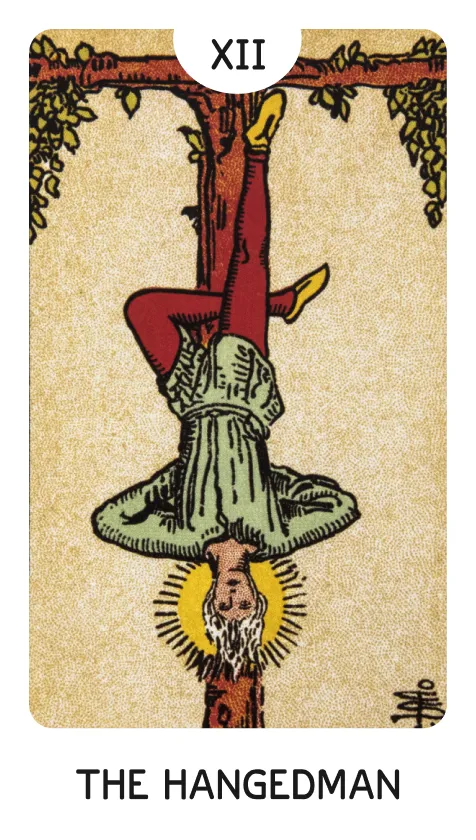
The blue color, associated with Water and the letter Mem, is present in the clothing of the Hangman, emphasizing the connection to this element.
The shape of the blue pants resembles the outline of the letter Mem, further strengthening the symbolic link.
The numerical value of Mem in Kabbalistic numerology is 40. Arthur Waite subtly integrated this detail into the card's design by depicting the halo around the Hangman's head with forty rays, although he made this element less noticeable.
The inverted triangle, a symbol of the Water element, is represented in the card's design in three ways:
The branches and trunk of the tree, forming the shape of the letter Tau, come together to create an inverted triangle.
The outline of the Hangman's crossed legs also resembles an inverted triangle.
The shape created by the two bent elbows and the halo around the Hangman's head also forms an inverted triangle.
This card depicts a symbolic image of Christ crucified on the cross, who realizes that his sacrifice will bring light and redemption to humanity. It also represents a guru who has attained the state of samadhi, where he can know and attain enlightenment.
It is also associated with the god of the waters, Neptune, who plunges into the depths of the spiritual ocean.
This mystical state of complete detachment and self-sacrifice, done for the purpose of union with the Divine, is the Annihilation of the self, which is considered necessary in India to achieve Nirvana.
It is our inner spiritual essence, revealed through the sacrifice of our own self and submission of our will to the Divine will.
The gallows on this card is represented in the form of a Tau cross, and the posture of the figure, especially its legs, forms a cross in the shape of a swastika. Above the head of the figure, perceived as an imaginary martyr, there is a halo.
It is important to note that: 1) the tree from which the figure hangs is full of life and has leaves; 2) the expression on the figure's face reflects a state of deep meditation, not suffering; 3) the entire figure symbolizes suspended life, not death.
The meaning of this card is multifaceted, but its essence is hidden. As some editors and commentators of Eliphas Levi have suggested, he himself may not have fully understood this profound meaning.
It has been interpreted as a symbol of martyrdom, prudence, the Great Work, duty, but all these interpretations only reflect a superficial perception.
I suggest looking at this card as a reflection of the relationship between the Divine and the Universe.
Those who realize that this symbol embodies the story of their higher nature gain clues to a great awakening and an understanding that after the Sacred Mystery of Death comes the glorious Mystery of Resurrection.
On the Hangman card, the dominant cosmic force is Neptune, the planet of illusions and enlightenment. The card symbolizes a departure from the ordinary view of life and the willingness to sacrifice something for more significant goals.
The figure on the card is depicted in an upside-down position, indicating a renunciation of selfish desires and the habit of relying on personal judgments in complex situations.
This inverted image signifies a rejection of conventional life attitudes and a dedication to spiritual development and the understanding of the divine.
Despite the unusual posture, the character on the card does not experience suffering; their face expresses tranquility and serenity, which is also evidenced by the halo of light around their head.
The life of the Hangman is in the hands of the Higher Power. His passions, represented by the red stockings, are subdued; the subconscious, symbolized by the blue clothing, is freed from the burden of memories.
Actions, passions, memories, and intellect, represented by the yellow shoes, have lost their significance in the face of spirituality.
The number XII (12) on the card combines the number of the Magician (1), symbolizing conscious mind, and the number (2), representing the feminine subconscious element. Both aspects relinquish their initial functions, making way for complete spiritual dedication.
The card reflects the goal of yogic meditation – achieving a state of samadhi, where both the subconscious and conscious mind are at peace, preparing for divine unity.
The living tree symbolizing life in the spirit supports the Hangman, and the rope on which he hangs represents a direct connection with the Cosmos.
Keep exploring
All 78 cards →
A READING THAT FEELS LIKE YOU
Your cards.Your kind of clarity.
Go beyond a card meaning. Explore personal tarot readings, choose your reader and keep the conversation going in Lumi.
Your next reading is a download away.