Wheel of Fortune
Wheel of Fortune — Upright
The card 'Wheel of Fortune' in the context of Tarot symbolizes a period of favorable changes leading to progress and the expansion of horizons, possibly in new directions.
This card promises a positive transition, opening doors to opportunities and growth. Advice for the Seeker — use this moment to lay a strong foundation for future success.
The 'Wheel of Fortune' often signifies the beginning of a new and more successful stage in life. This period may require calculated risks, but with the appearance of this card in the spread, the chances of success significantly increase, foreshadowing a favorable outcome of events.
A meaning is only the beginning.
Explore what this card brings to your own question.
Wheel of Fortune — Reversed
With the reverse side of the 'Wheel of Fortune', the previous cycle marked by a decline returns. There is a need to restart a project or tasks that the Seeker considered completed.
Efforts and endeavors seem futile, as if the Seeker is consistently facing insurmountable obstacles.
The Seeker is accompanied by obstacles and delays; luck temporarily turns away from them.
Reversed 'Wheel of Fortune' may indicate a repetition of past mistakes or a failure to see new opportunities on the horizon.
There are issues with timing: for example, when the Seeker is ready to seize opportunities, they do not materialize, and vice versa.
Astrology
The Wheel of Fortune is ruled by Jupiter, the planet of expansion, fate, and change. Sagittarius adds optimism, exploration, and philosophical understanding. Together, they reflect cycles of destiny, fortune, and the evolution of experience.
Numerology
Number 10 symbolizes cycles, destiny, and change. It reflects the essence of the card’s role in the journey, guiding insight through the lens of 1. The reduced number 1 brings focus to universal lessons and recurring themes.
Symbolism & Archetypes
Explore the symbolism — open a section to read more.
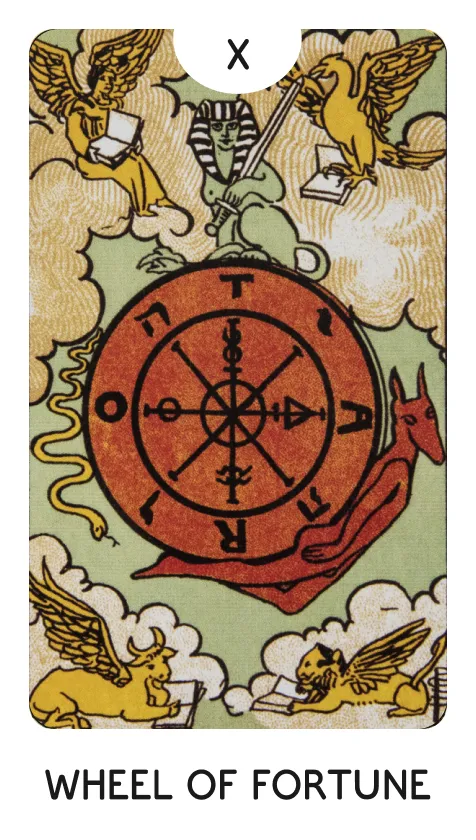
The Wheel of Fortune card in Tarot, associated with the Kabbalistic attribute of the Hebrew letter Kaf, is linked to the planet Jupiter. This card, while not containing explicit clues, symbolizes the Kabbalistic idea of duality.
In Jewish mystical tradition, the 22 letters of the alphabet are divided into three groups: 12 are related to the zodiac, 7 to planets, and 3 to elements. The Jupiter card is represented with clouds in the corners, symbolizing the influence of Jupiter, and a sky-blue background, corresponding to the color of this planet.
The figure with a jackal's head resembles the zodiacal symbol of Jupiter, where the curved back symbolizes the crescent moon, and the crossed legs represent a cross. The four cherubic angels located in the corners are associated with Jupiter's number, four.
The sum of the numbers 5, 8, 11, and 2 equals the numerical value of the Tetragrammaton (26).
The wheel in the center of the card also has a Jupiterian origin, containing a four-part pattern. The pentacle on the wheel, drawn by Eliphas Levi, combines four groups of symbols: the Tetragrammaton, the four cherubic angels, the word ROTA, and four alchemical symbols representing the elements.
These correspondences emphasize the profound mystical significance of the Wheel of Fortune as a symbol of cyclicality, transformation, and the influence of divine providence on human life.
The Wheel of Fortune card in Tarot symbolically reflects universal cycles of existence, serving as a metaphor for the wheel of life and death.
It is a wheel on which souls ascend to the peaks of life's experiences and descend back, assuming new earthly forms.
It echoes the concept of Yin and Yang in Chinese philosophy, where opposites are inseparably connected and constantly transition into each other, creating harmony in the universe.
In Hinduism and Buddhism, it represents the Wheel of Samsara, symbolizing the endless process of rebirths and the quest for enlightenment.
In Tantric Buddhism, this card is associated with the Kalachakra, the Great Wheel of Time, reflecting the eternal cycle of destruction and rebirth, where each end heralds a new beginning.
It is a symbol of the perpetual movement of life, where each stage of the life path serves as a prelude to the next transition.
The Wheel of Fortune card in Tarot represents a symbol of constant movement and the ever-changing nature of life. It embodies the idea of an eternal cycle and change, symbolizing the turning of fate and time.
In the reconstruction by Eliphas Levi, the card includes elements of Egyptian symbolism, representing Typhon in the form of a serpent, as well as the Four Living Creatures from Ezekiel's vision, symbolizing stability in the universal flow.
The Sphinx on the card symbolizes balance and harmony in a constantly shifting world. On the rim of the wheel, there are letters forming the word Taro as Rota, alternating with letters from the Divine Name, emphasizing the all-encompassing role of Providence.
The card also carries the idea of denying randomness, highlighting the fatalistic nature of destiny.
Going beyond surface and literal interpretations, the card reminds us of the profound philosophical and spiritual aspects of life, asserting that life adheres to certain laws and rhythms that go beyond mere chance.
The Wheel of Fortune card in Tarot symbolizes the cyclical nature of life, where each rotation of the wheel leads to alternating highs and lows, joys and sorrows.
The image of a person rising and falling from the wheel emphasizes the apparent randomness and unpredictability of life events, reminding us of constant movement and change.
However, a deeper understanding of the Tarot arcana reveals a more complex meaning of this symbol. After traversing the spiritual path of the Hermit, the Wheel of Fortune opens new levels of awareness for the initiated.
It is not merely a game of chance but a path to understanding the hidden laws of the Universe, which become accessible after trials and difficulties.
The card is also associated with Jupiter, symbolizing prosperity and good fortune, which harmonizes with the idea of favorable changes and new ventures.
The card's number, 10, symbolizes the completion of one phase and the beginning of a new one, emphasizing the endless cycle of rebirth and renewal in a person's life.
Keep exploring
All 78 cards →
A READING THAT FEELS LIKE YOU
Your cards.Your kind of clarity.
Go beyond a card meaning. Explore personal tarot readings, choose your reader and keep the conversation going in Lumi.
Your next reading is a download away.