The Chariot
The Chariot — Upright
The Chariot card in Tarot symbolizes the triumph of the intellect over material concerns, highlighting the importance of self-control, balance, and discipline in overcoming life's challenges.
This card emphasizes the harmony between the emotional and intellectual aspects of one's personality, ensuring stability and independence from fleeting moods.
The central position of the charioteer on the chariot signifies the concept of centeredness. It calls for the analysis of one's own feelings and thoughts, reflecting on the authenticity of external appearances and inner essence.
Steering the chariot without reins symbolizes control through mental energy and insight, harmonized with love and compassion for others.
The Chariot is also a symbol of control over behavioral habits, illustrating success in restraining negative emotions, views, and dependencies.
The card's key theme is overcoming obstacles and using the achieved victory for further development.
The card also predicts an individual's search for their unique path of self-expression, their 'chariot,' signifying the discovery of an individual way to fulfill oneself.

A meaning is only the beginning.
Explore what this card brings to your own question.
The Chariot — Reversed
When the Chariot card appears in a reversed position in Tarot, it symbolizes a loss of control over the mind and an overflow of emotions. This indicates that the Seeker has strayed from their goals and lost their direction.
In the context of divination about harmful habits and addictions, the reversed Chariot can signify a return to old, negative behavioral patterns, such as drug abuse, smoking, or overeating.
In such cases, it is important to advise the Seeker to reconsider their behavior and take control of themselves to avoid further self-destruction and recklessness.
The reversed Chariot warns of potential defeat or failure arising from a lack of self-discipline or inconsistency in decisions and actions.
Astrology
The Chariot is aligned with Cancer, ruled by the Moon, symbolizing willpower, emotion, and protection. This pairing balances drive with emotional intelligence. It reflects inner strength, focused movement, and purposeful direction.
Numerology
Number 7 symbolizes willpower, challenge, and inner control. It reflects the essence of the card’s role in the journey, guiding insight through the lens of 7. The reduced number 7 brings focus to universal lessons and recurring themes.
Symbolism & Archetypes
Explore the symbolism — open a section to read more.
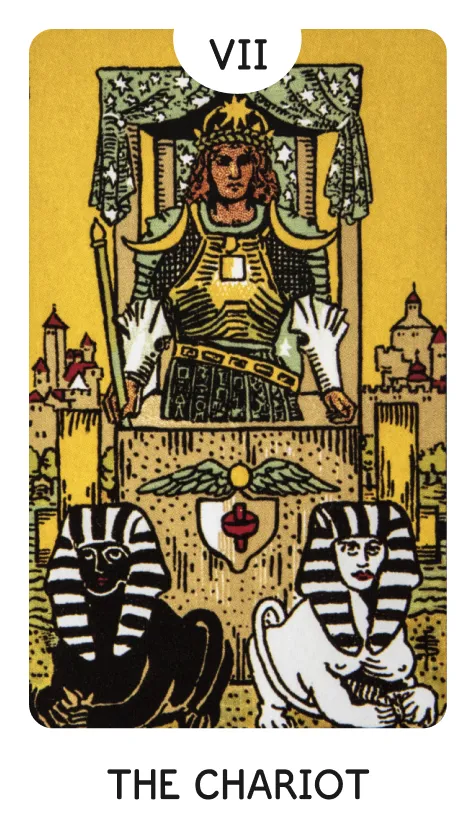
On the Chariot card in Tarot, which is Kabbalistically associated with the Hebrew letter Chet and the zodiac sign of Cancer, we see an image of a charioteer steering a chariot. This card is closely connected to the Moon, which is expressed through various symbols.
On the charioteer's belt, there are symbols of Cancer and the Moon.
The charioteer's epaulets in the form of two crescents with faces symbolize joy and sadness, corresponding to the sign of Cancer ruled by the Moon.
The shape of the charioteer's armor resembles the sign of Pisces, creating a connection to the High Priestess and the Moon.
Thus, Waite establishes astrological associations in his Arcana, linking the Moon to the High Priestess, Cancer to the Chariot, and Pisces to the Moon.
In Kabbalah, the letter Chet signifies a fence or wild animals, which is reflected in the Chariot card through the wall that surrounds the city and the two sphinxes pulling the chariot.
The crab's shell on the charioteer serves as both protection and signifies his mobile home, akin to a chariot. The canopy studded with stars also alludes to Cancer as a sign ruled by the Moon, the mistress of the night sky.
Kabbalistically, Chet corresponds to the eighteenth Path on the Tree of Life, interpreted as the House of Influence in the Golden Dawn, signifying the role of astrological fate.
This is emphasized by the blue fabric of the canopy with stars, rising above the charioteer as a symbol of the night sky.
The Chariot card in Tarot symbolizes Apollo, the god of the sun, racing across the skies in his majestic chariot. This image recalls the fiery chariot from the biblical story of Ezekiel, which transports the prophet to other realms.
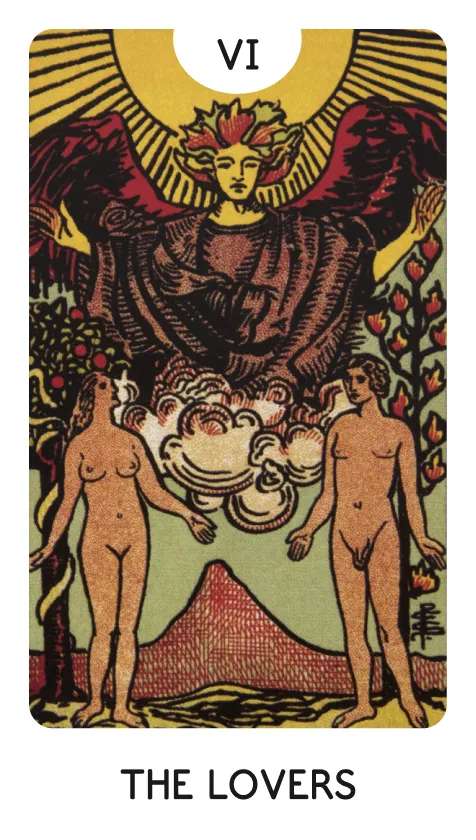
After overcoming the temptations presented in the Lovers card, the Charioteer gains the opportunity to display their great power. The Chariot card represents victory through achieving balance.
The charioteer could have used their newfound qualities for selfish purposes, but instead, they resist the allure of vanity and materialism depicted in the background of the card.
They leave behind the world of illusions, gravitating towards spiritual growth and the refinement of the virtues of their soul.
The Chariot card in Tarot depicts an energetic and majestic character holding a sword, symbolizing strength and determination, although it differs from Pamela Colman Smith's traditional depiction.
On his shoulders are the Urim and Thummim, ancient Jewish religious artifacts symbolizing a connection to higher realms and the ability to prophesy.
This hero symbolizes victory on all levels – in intellectual achievements, scientific progress, and certain initiation trials.
He successfully deciphered the Sphinx's riddle, which is why his chariot is led by two sphinxes, according to Eliphas Levi's version. This character represents the triumph of reason and logic.
However, it's important to understand that a) his victories pertain to the secrets of nature, not the spiritual world; b) his achievements are external and overt; c) his successes may leave him ensnared in logical thinking; d) his initiation trials should be viewed in a physical or rational context; and e) if he were to approach the pillars of the Temple where the High Priestess sits, he wouldn't be able to unfurl the Torah scroll or answer her questions. He is not a hereditary ruler or a priest.
The Chariot card in Tarot depicts a powerful, light-haired man driving a chariot. This symbol represents the integration of conscious and subconscious qualities, reaching unity with higher consciousness.
As an embodiment of the concept introduced in the Lovers card, the charioteer demonstrates a new level of control and balance over emotions, represented in the form of sphinxes. He has learned to steer his moods, balancing between positive and negative aspects of his feelings.
The card's association with the sign of Cancer in astrology emphasizes its emotional depth. In the Chariot, the spiritual essence guides and directs the individual's new aspirations. The presence of the number seven on the card symbolizes victory and spiritual enlightenment, pointing to life lessons and achievements.
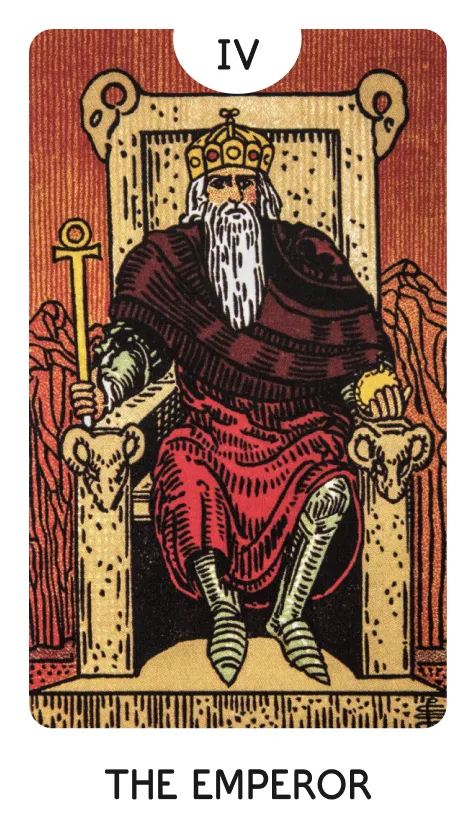
The canopy above the charioteer's head, adorned with stars and supported by four columns, as well as the chariot's cube-like shape, allude to a connection with the Emperor card and dominance over reality and the physical nature.
Urim and Thummim, mentioned in the text, are attributes of the ancient Jewish priest and symbolize divine knowledge and a connection with higher forces. These elements represent light or revelation and perfection or truth, corresponding to the metaphysical image of the charioteer.
Keep exploring
All 78 cards →
A READING THAT FEELS LIKE YOU
Your cards.Your kind of clarity.
Go beyond a card meaning. Explore personal tarot readings, choose your reader and keep the conversation going in Lumi.
Your next reading is a download away.