The Hierophant
The Hierophant — Upright
The Hierophant card in Tarot often points to a traditional or conservative approach to the topic at hand. It may represent the use of established methods or standard approaches in actions, as well as the presence of intuitive guidance or wisdom.
In the context of work, health, family, or material matters, the Hierophant symbolizes adherence to established practices.
In relationships, this card can signify an official marriage union where partners adhere to traditional roles and responsibilities.
In the professional sphere, the Hierophant may indicate work in a structured, conservative organization or education in a prestigious institution where strict adherence to rules and norms is required.
When it comes to health readings, the Hierophant may suggest the use of standard medical procedures and treatment methods.
In spiritual matters, this card can represent the image of a spiritual mentor or the inner voice of the Querent, influencing the development of events.
The recommendation for the Querent in such a case is to pay attention to the advice of their spiritual mentor and their inner intuition.
In many cases, the Hierophant card may symbolize not so much a spiritual leader but rather a teacher or mentor who plays a key role in the matter at hand.

A meaning is only the beginning.
Explore what this card brings to your own question.
The Hierophant — Reversed
When the Hierophant card in Tarot appears in a reversed position, its meaning is opposite to its upright interpretation. It symbolizes individuality, uniqueness, independence, and a tendency to experiment in the matter at hand.
In the context of practical solutions, the reversed Hierophant predicts the use of innovative, non-standard methods. In matters related to marriage, it may indicate a civil union or unusual circumstances in the marital relationship.
In health readings, the reversed Hierophant may suggest the benefit of innovative, modern, or experimental treatment methods.
In the professional sphere, the Querent may encounter unique, non-standard situations, while in the educational field, cutting-edge teaching methods may be employed.
In spiritual matters, the reversed Hierophant may foretell a refusal or disregard of internal intuitive guidance, indicating a possible departure from traditional spiritual paths or neglect of them.
Astrology
The Hierophant corresponds to Taurus, a sign of tradition, stability, and material wisdom. Ruled by Venus, it adds reverence for ritual, values, and cultural systems. The card reflects spiritual authority and the guidance of established beliefs.
Numerology
Number 5 symbolizes tradition, learning, and spiritual guidance. It reflects the essence of the card’s role in the journey, guiding insight through the lens of 5. The reduced number 5 brings focus to universal lessons and recurring themes.
Symbolism & Archetypes
Explore the symbolism — open a section to read more.
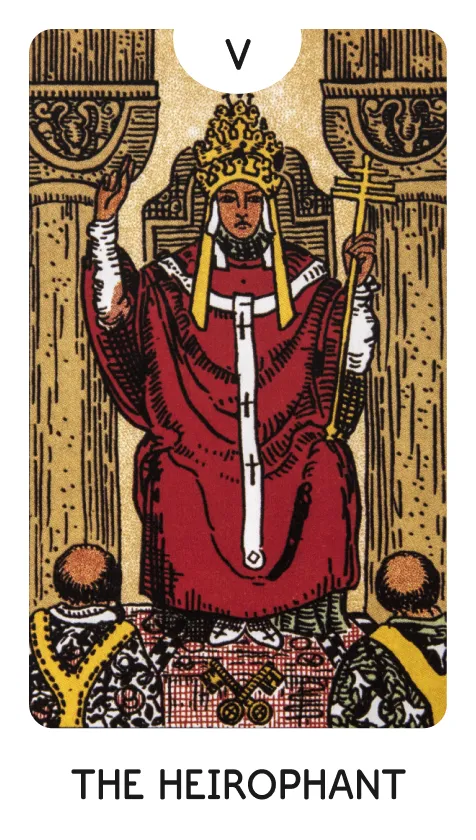
The Hierophant in Tarot is associated with the Kabbalistic letter Vav and the zodiac sign Taurus. The deck's creator, Arthur Waite, incorporated hidden symbols and signs into this card to reflect this connection.
Ancient Form of the Letter Vav: This form, resembling the English letter Y, appears on the garments of two clergy members in the foreground of the card and on the white chasuble worn by the Hierophant.
Transliterations of the Letter Vav: Waite included three English transliterations of the letter Vav - U, V, and W:
U is found on the capitals of the columns on either side of the Hierophant.
V is represented as a Roman numeral above the Hierophant's head.
W is located below the Roman numeral V on the Hierophant's crown.
Zodiacal Symbol of Taurus: This symbol, presented as two circles with dots, positioned on the protrusions of the throne's vault, forms a stylized Taurus symbol. Each circle with a crescent moon creates a graphic representation of this sign.
Color Symbolism: The red-orange color of the Hierophant's attire and the carpet beneath his throne corresponds to Taurus in the Golden Dawn system.
The planetary ruler of Taurus, Venus, is symbolized by the flowers on the vestments of the Hierophant's assistants, while the Moon, exalted in Taurus, is depicted with a blue under-vestment worn by the Hierophant.
Thus, the V Hierophant card in Tarot represents a complex symbolic image in which each element carries hidden meanings associated with Kabbalistic and astrological attributes.
The Hierophant in Tarot symbolizes various types of spiritual leaders and teachers, such as the Pope, Protestant pastor, rabbi, guru, and other figures who serve as a bridge between God and humanity.
This image personifies a spiritual patriarch, a wise guide who directs and enlightens, serving as the link between the divine and the earthly.
The card also reflects the inner spirituality inherent in each individual. It symbolizes the intuitive aspect of our personality that comprehends and evaluates the spiritual significance and importance of our life experiences.
The Hierophant represents an inner mentor, assisting us in understanding and integrating external events with our spiritual understanding.
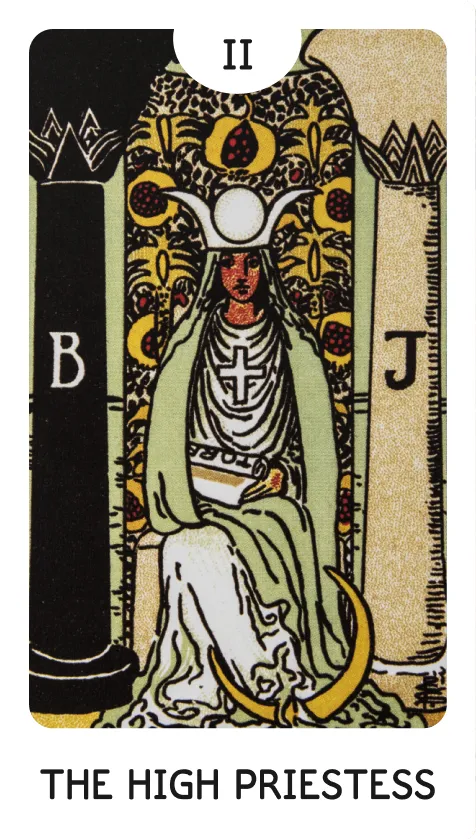
The Hierophant, as depicted in the Tarot card, is an important figure dressed in a triple crown and seated between two pillars. These pillars are distinct from those found with the High Priestess.
In the Hierophant's left hand, there is a scepter that ends with a triple cross, and with his right hand, he makes a gesture known as the esoteric sign, symbolizing the division between explicit and hidden teachings.
Unlike the High Priestess, the Hierophant actively uses gestures. At his feet are crossed keys, and in front of him, two attendants in robes are kneeling.
The Hierophant is often referred to as the Pope, which only partially reflects his broader function. He represents the authority of external religion, while the High Priestess is associated with esoteric and withdrawn authority.
Despite many interpreters distorting its true meaning, the Grand Orient correctly points out that the Hierophant symbolizes the forgiveness of sins, exoteric orthodox teaching, and the external aspect of life leading to this teaching.
However, he is not the prince of occult teaching but rather represents the summa totius theologiae in its most entrenched form, symbolizing all that is righteous and holy on the manifested side.
The Hierophant is a conduit of grace in the world of human institutions, distinct from the world of Nature, and a leader on the path of humanity's salvation. He represents order and the head of an established hierarchy, reflecting a higher hierarchical order.
However, there is a risk that the High Priest may forget the symbolic significance of his status, acting as if he himself embodies everything symbolized by his gesture or symbol.
The Hierophant is not philosophy in the usual sense, although he may be in a theological context; he is not inspiration; and he is not the religion itself, although he is one of its expressions.
The Hierophant, as depicted in Tarot, embodies the image of a majestic ecclesiastical hierarch dressed in robes of righteousness. He symbolizes standard and traditional teachings accepted by the masses unquestioningly, akin to monks bowing before him.
The Hierophant personifies that part of our soul which, like a teacher, occasionally inspires us with inner revelations and insights, aiding us in finding spiritual balance and the ability to listen to our intuition.
The vestments of the Hierophant are colored in shades of red-orange, characteristic of the Taurus sign.
This connection between the bull symbol and the Hierophant sparks profound reflections on whether we see the Divine Word in lavish church adornments and rituals or seek divine presence within the depths of the soul through intuition and inner understanding.
The Hierophant, meaning supreme priest, is a symbol of spiritual authority and various religious movements. His authority is emphasized by a complex crown and scepter.
The crown with its three tiers and a smaller fourth one at the top symbolizes the four levels of creation over which he gained dominion in his role as the Emperor.
The Hierophant card is marked with the number V (5), symbolizing change. It shifts our focus from the external world of the Emperor's rational thinking to the internal realm of spirituality.
The lilies on the robe of one of the monks indicate spiritual idealism, while the roses on the attire of another monk symbolize love for humanity, which led him to the teacher for guidance and instruction.
The Hierophant represents a teacher, Pope, guru, priest, preacher, or rabbi, as well as an inner spiritual teacher who may be perceived as a mentor, higher self, conscience, or guardian angel.
The connection with this spiritual advisor is established through the intuitive subconscious qualities of the High Priestess (symbolized by the silver key), leading to the unlocking of the superconscious (golden key).
Note: In some Tarot decks, it may be challenging to distinguish between silver and gold colors.
Keep exploring
All 78 cards →
A READING THAT FEELS LIKE YOU
Your cards.Your kind of clarity.
Go beyond a card meaning. Explore personal tarot readings, choose your reader and keep the conversation going in Lumi.
Your next reading is a download away.