The High Priestess
The High Priestess — Upright
The High Priestess card in Tarot is usually associated with the presence of hidden or secret influences on the question at hand. Often, its appearance in a spread indicates the questioner's doubts about the topic of interest and the need for additional information or understanding of future events.
The symbol of the Moon on the High Priestess card represents possible changes in the situation that the questioner may not be aware of.
This card often symbolizes the subtle forces that affect the questioner's issue, even if they believe they fully understand the situation. The appearance of the High Priestess underscores that all aspects of the situation may not yet be revealed.
Additionally, the card may indicate the presence of intuitive or extrasensory powers influencing the reading. It may be related to dream interpretation or perceiving key moments.
The card can also symbolize an ethical approach to problem-solving and honest actions. The questioner is advised to follow their moral and ethical principles.
In the final outcome position, the card foreshadows hidden favorable changes, urging the questioner to exhibit virtue and steadfastness in their beliefs. The High Priestess is now considered a signifier for women in the spread.
A woman who prefers this card typically possesses a strong intuition and a philosophical outlook on life, which may be influenced by formal religious teachings or develop naturally.
She respects the personal rights of others and keeps her beliefs to herself, acting rather than preaching. Her inner peace and harmony depend on her fidelity to her own values. She finds true satisfaction in deep spiritual resonance with the flow of intuition.
Being an idealist, she sets high expectations for herself and others and experiences disappointment when they are not met. In a spread, the High Priestess can represent both the questioner themselves and the aforementioned woman playing a significant role in the discussed matter.
A meaning is only the beginning.
Explore what this card brings to your own question.
The High Priestess — Reversed
When the High Priestess card appears in a reversed position, it often symbolizes the disharmony between a person's personal life and their moral beliefs. This can manifest in the form of compromise or the abandonment of important ethical principles for the sake of another person or a situation related to the question at hand.
The questioner may find themselves in a conflicting or unstable situation and instead of actively seeking a solution or changing circumstances, they remain in a state of passivity. It may be that feelings of revenge, condemnation, or bitterness are building up inside them.
Astrology
The High Priestess corresponds to the Moon, symbolizing intuition, mystery, and the unconscious. Cancer enhances her emotional depth and spiritual receptivity. Together, they represent hidden knowledge, inner truth, and sacred silence.
Numerology
Number 2 symbolizes balance, duality, and inner wisdom. It reflects the essence of the card’s role in the journey, guiding insight through the lens of 2. The reduced number 2 brings focus to universal lessons and recurring themes.
Symbolism & Archetypes
Explore the symbolism — open a section to read more.
The High Priestess card in Tarot is associated with the Kabbalistic symbol of the Hebrew letter Gimel (ג), which is linked to the Moon. Arthur Waite introduced a series of symbols to emphasize this lunar connection:
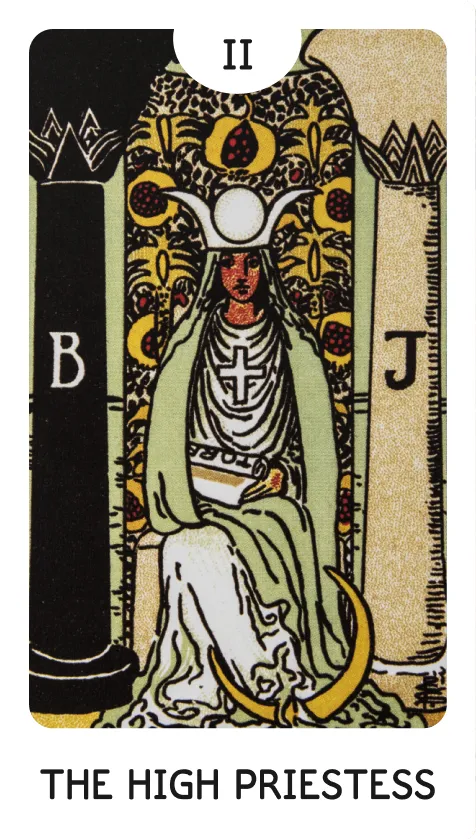
The explicit symbol of the Moon on the card is the lunar crescent, which floats on the waves of the Priestess's mantle, unequivocally connecting the card's symbolism with the Moon.
This is important because the esoteric order of the seven planets is the key to understanding the Kabbalistic attributes in Tarot. The order was carefully studied and refined by Waite in accordance with the works of Mathers.
The curtain behind the High Priestess, adorned with pomegranates and palm trees, is shaped like the Kabbalistic Tree of Life. The placement of the crown and the head of the Priestess on the card indicates the position of Arcanum II (Gimel) on the Tree of Life.
The upper pomegranate on the curtain corresponds to Keter (the first Sephira), while the solar cross on the Priestess's chest corresponds to Tiferet (the sixth Sephira), signifying the path of Gimel that connects these points.
The additional connection between the High Priestess and the Moon is emphasized in Arcanum XVIII — the Moon card. In the Sefer Yetzirah, this Arcanum is often associated with the sign of Pisces, not the Moon.
This created confusion, but Waite depicted the lunar crescent on Arcanum II (rather than Arcanum III, as in the French Tarot de Marseille), indicating that it is indeed Arcanum II that corresponds to the Moon.
The headpiece of the High Priestess in the form of two crescent-shaped horns and the descending veil encodes the zodiacal symbol of Pisces, reminiscent of two connected lunar crescents, confirming the Kabbalistic-astrological attributes:
Arcanum II = Gimel = Moon;
Arcanum XVIII = Koph = Pisces.
This Tarot card portrays a majestic and serene woman who confidently follows her life's path in complete harmony with her personal beliefs. She possesses clairvoyant abilities, penetratingly gazing into the past and the future.
She can also be a loyal friend or counselor, ready to listen attentively and provide a thorough assessment of the situation.
This image resembles that of a vestal from ancient times, guarded and isolated in a sanctuary, filled with virtues and spiritual purity. Thanks to her deep sensitivity to the psychic world, priests received their revelations.
She is a symbol of the inner soul, hidden during the daylight hours but beckoning in the dark of night, enriching life with a wealth of dreams and symbols.
This card represents a devout and pious woman, exemplary in her purity, devotion, and determination to achieve her goals. It also symbolizes the subconscious abilities within each person, lying in a state of dormancy, waiting for the moment of awakening and development.
The High Priestess card in the Tarot depicts a figure with a crescent moon at her feet, a diadem with horns and a sphere on her head, and a large solar cross on her chest.
In her hands, she holds a scroll with the inscription Torah, symbolizing the Higher and Secret Law, partially concealed by her mantle, emphasizing that some truths are implied but not spoken aloud.
She sits between two columns marked with the letters J and B in a mystical Temple, behind her hangs a curtain adorned with palm trees and pomegranates.
Her robes flow in transparent waves, and her mantle symbolizes light – a sparkling radiance.
The High Priestess is known as the Occult Science at the threshold of the Temple of Isis, representing the Secret Church, the home for both God and man. She embodies the Spiritual Bride and Mother, the daughter of the stars and the Garden of Eden.
She is also the Queen of light, the source of which is the Moon, nourished by the milk of the Supreme Mother. In a sense, she is also the Supreme Mother herself, her bright reflection. In Tarot symbolism, her highest name is Shekhinah, which means splendor.
According to Kabbalistic teachings, Shekhinah exists in both the higher and lower worlds, in the higher world known as Binah – the Highest Understanding, and in the lower as Malkuth – the kingdom, blessed with the glory of the Lord.
Shekhinah, in a mystical sense, is the Spiritual Bride of the righteous person, imparting divine meaning to their reading of the Law. In some aspects, this card is considered the most sacred and highest among the Major Arcana.
The High Priestess card in Tarot is distinct in nature from the Magician and the Fool cards. The High Priestess is dressed in blue colors, reflecting the passive receptivity of the water element, unlike the active and energetic colors of the Magician.
Her essence is distinctly feminine, and the source of her power lies in the realm of the soul and the subconscious. In the past, these aspects were shrouded in mysticism and only accessible to the initiated, who knew how to control and develop these facets of their personality and energy.
The symbolism of water, often associated with the subconscious, includes fluidity and reflective properties. Water can symbolize memory as the recording of a person's personal history.
The concept of the fluidity of the subconscious is linked to its ability to absorb and process human thoughts, feelings, and experiences, forming patterns in memory.
On the High Priestess card, water flows from her robes into a tranquil sea, symbolizing various qualities of the subconscious, such as telepathy, prophetic abilities, clairvoyance, and intuitive communication through symbolic language.
The subconscious helps in telepathically harmonizing with others, provides intuitive understanding of situations through the language of dreams, and predicts the future. The number of the High Priestess is II (2), symbolizing two sources of water: personal and cosmic subconsciousness.
The double wings of her mantle represent two aspects of the subconscious: psychic connection with the past, present, and future, as well as the subconscious's ability to transform life events into symbols.
The two moons on the card, one on the head of the High Priestess and the other in the form of a crescent at her feet, symbolize variability, oscillation, and cyclicality. The changing phases of the moon from full to new underscore the hidden, invisible nature of what the High Priestess represents.
Keep exploring
All 78 cards →
A READING THAT FEELS LIKE YOU
Your cards.Your kind of clarity.
Go beyond a card meaning. Explore personal tarot readings, choose your reader and keep the conversation going in Lumi.
Your next reading is a download away.